Contact center artificial intelligence (AI) is reshaping customer service by helping teams respond faster, resolve issues more accurately, and deliver more consistent experiences across every channel. Instead of treating support as a cost center, many organizations use AI to unlock measurable gains in efficiency, customer satisfaction, and agent performance.
At its best, AI does not replace the human touch—it amplifies it. When integrated with omni channel contact center software, AI can automate repetitive tasks, surface the right knowledge at the right time, and analyze conversations at scale. This enables agents and supervisors to focus on what matters most: empathy, judgment, and problem-solving. This approach exemplifies intelligent automation for AI contact centers.
As investment decisions become more strategic, reviewing contact center artificial intelligence pricing is a key step in planning deployment. Costs can differ based on cloud versus hybrid environments, advanced AI modules enabled, integration requirements, and scalability needs across channels. A transparent pricing framework allows organizations to model total cost of ownership, compare vendor approaches, and ensure AI initiatives deliver measurable business impact without unexpected budget overruns.
This guide breaks down what contact center AI is, where it creates the biggest benefits, and how to implement it in a practical, value-driven way.
What is contact center artificial intelligence?
Contact center AI refers to the use of machine learning and related technologies to assist or automate customer interactions and operational workflows. In practice, it typically includes capabilities such as:
- Conversational AI for self-service via chatbots and voice bots
- Agent assist that recommends responses, next steps, and knowledge articles during live conversations
- Intelligent routing that matches customers to the best agent or queue based on intent, skills, language, and context
- Speech analytics and text analytics to summarize, classify, and extract insights from interactions
- Quality management automation to evaluate more interactions and identify coaching opportunities
- Workforce optimization support through forecasting signals and trend detection
These tools can operate across channels such as voice, email, chat, social messaging, and in-app support. The most effective deployments connect AI to your customer data, knowledge base, and contact center platform so the system can respond with context, not guesswork, which is central to ai for contact center success.
Why AI is a big deal for contact centers
Customer expectations keep rising: faster answers, fewer transfers, consistent information, and seamless channel switching. Contact centers also face ongoing pressure to do more with less, while protecting employee wellbeing and maintaining compliance.
AI helps bridge that gap by improving both the customer experience and the operational model at the same time. When implemented thoughtfully, ai for contact centers supports scalable, efficient, and high-quality service, and the right ai contact center software makes these improvements practical and sustainable for modern organizations.
- Reduce wait times and speed up issue resolution
- Improve first-contact resolution by guiding agents with better information
- Increase consistency in tone, compliance language, and process adherence
- Enhance coaching and training with richer performance insights
- Make support more scalable without sacrificing quality
Top Contact Center Artificial Intelligence Solutions
Artificial Intelligence (AI) is transforming contact centers by automating repetitive tasks, improving agent productivity, and delivering personalized customer experiences. AI tools can handle routine inquiries, route customers intelligently, provide real-time agent guidance, and analyze conversations to enhance overall performance. Here are some of the leading AI solutions for contact centers:
1. Bright Pattern — Best Overall AI Contact Center Solution

Bright Pattern is a fully AI-powered contact center platform designed to provide seamless customer experiences across all communication channels. It combines advanced AI automation, real-time agent assistance, and omnichannel capabilities in one intuitive platform.
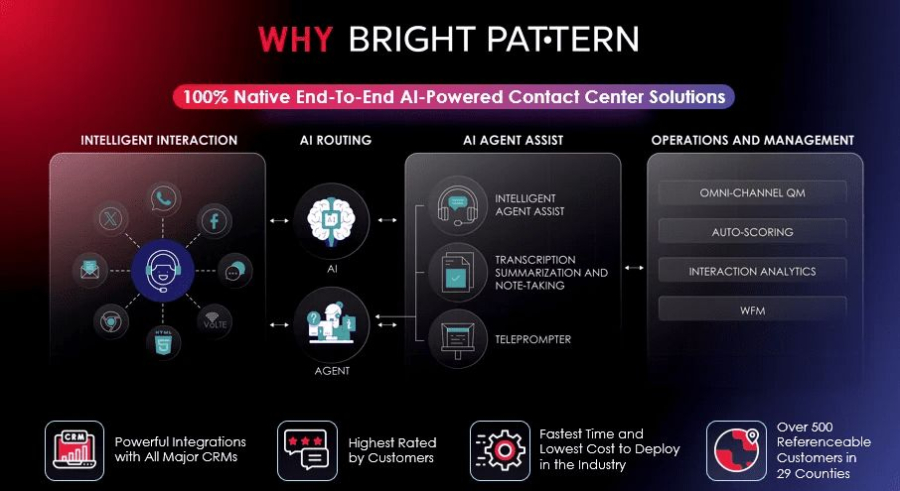
Key Features and Benefits:
- AI Virtual Agents: Automate common inquiries like FAQs, order tracking, appointment scheduling, and billing questions, freeing agents to focus on complex interactions.
- Intelligent Routing: AI matches customers to the right agent based on skill, context, history, and sentiment, ensuring faster resolutions and higher satisfaction.
- Omnichannel Engagement: Supports voice, chat, email, SMS, and messaging apps in a unified interface, so customers experience seamless service across channels.
- Real-Time Agent Assist: Offers AI-powered guidance, suggesting next-best actions, responses, and knowledge articles, helping agents handle calls more efficiently.
- Analytics and Insights: AI analyzes interactions in real-time and post-interaction to provide actionable insights, performance metrics, and sentiment analysis.
- Scalable and Flexible: Highly configurable for businesses of all sizes and industries, supporting complex workflows without adding operational complexity.
- Enterprise Security & Compliance: Built for regulated industries, with robust data protection, monitoring, and compliance features.
Bright Pattern not only reduces average handling times but also improves first-call resolution rates and ensures a consistent, human-centric experience across every touchpoint. Its AI capabilities empower contact centers to operate efficiently, boost customer loyalty, and deliver measurable ROI.
2. Genesys Cloud CX
Genesys Cloud CX leverages AI for predictive engagement, intelligent routing, and customer journey analytics. It enables organizations to provide personalized and proactive service while optimizing operational efficiency.
3. NICE CXone
NICE CXone integrates AI for workforce optimization, automation, and analytics. Its real-time sentiment analysis and performance monitoring help improve agent productivity and customer satisfaction.
4. Talkdesk AI
Talkdesk AI offers automated workflows, virtual agents, and real-time agent guidance. It helps businesses accelerate support, improve accuracy, and scale quickly.
5. Amazon Connect
Amazon Connect uses AI technologies like Amazon Lex and Contact Lens for speech recognition, sentiment analysis, and virtual agents, enabling scalable and cloud-native customer engagement.
6. Zendesk AI
Zendesk AI enhances support workflows with conversational bots, knowledge base suggestions, and AI-assisted responses, helping teams deliver faster, more accurate support.
7. Microsoft Dynamics 365 Customer Service
Microsoft Dynamics 365 integrates AI to provide virtual agents, predictive insights, and real-time guidance, improving both agent performance and customer experiences.
8. Google Cloud Contact Center AI (CCAI)
Google CCAI delivers AI-driven virtual agents, real-time agent assist, and speech-to-text analytics. It’s highly customizable for businesses seeking tailored solutions.
9. Salesforce Service Cloud + Einstein AI
Salesforce Einstein enhances Service Cloud with AI-powered case routing, predictive recommendations, and intelligent automation, optimizing customer interactions.
10. Five9 Intelligent Cloud Contact Center
Five9’s AI tools include virtual agents, smart IVR, and agent assist features, helping businesses move from traditional call centers to AI-enhanced cloud environments.
Top benefits of contact center artificial intelligence
1) Faster resolutions through automation and smart assistance
AI can deflect routine questions to self-service and streamline the steps agents take to solve complex issues. Instead of searching multiple systems or asking customers to repeat details, agents can receive real-time prompts and summaries that reduce time spent on administrative work.
Common speed boosters include:
- Intent detection that identifies why the customer is contacting you
- Suggested replies that help agents respond quickly and accurately
- Auto-summaries that reduce after-call work by drafting notes and dispositions
- Workflow guidance that recommends next-best actions during the interaction
2) Better customer experiences through personalization
AI can personalize the experience by using available context such as account status, prior interactions, and customer sentiment signals. This supports more relevant responses and smoother handoffs between bot and agent.
Personalization can show up as:
- Recognizing repeat contacts and referencing prior case history
- Proactively offering the most likely solution based on the customer’s journey stage
- Routing customers to specialists when the issue is known to be complex
3) Consistent answers, even across large teams
In many contact centers, inconsistency is one of the biggest hidden drivers of escalations and recontacts. AI can help standardize responses by recommending approved knowledge content and ensuring key information is included.
This is particularly valuable when you have:
- Multiple sites or outsourced partners
- Rapid hiring cycles
- Frequent policy or product updates
- Multiple languages and regional variations
4) Stronger agent performance and confidence
Agent assist tools can act like a real-time support layer for new and experienced agents alike. New hires ramp faster because the system helps them navigate processes and locate the right information. Experienced agents benefit from quick retrieval of edge-case policies, tricky troubleshooting steps, and consistent compliance reminders.
In day-to-day operations, AI supports agents by:
- Reducing cognitive load during high-volume periods
- Helping maintain a friendly, on-brand tone
- Surfacing empathy cues and de-escalation guidance when sentiment turns negative
5) Always-on coverage without adding headcount
Conversational AI can provide 24/7 support for common tasks such as order status, password resets, appointment scheduling, and basic troubleshooting. When the issue becomes complex, the bot can capture details and hand off to an agent with a concise summary, making the live interaction more efficient.
6) Real-time and long-term insights from every interaction
Traditional reporting often samples a small subset of calls for quality review. AI-driven analytics can scale evaluation and discovery across a much larger portion of interactions, revealing trends that are easy to miss.
Analytics can help you:
- Identify top contact drivers and emerging issues
- Detect where customers get stuck in self-service
- Spot knowledge gaps and training needs
- Track sentiment patterns and escalation triggers
- Measure adherence to required disclosures or scripts
Where contact center AI delivers the most value (use cases)
The highest-return use cases often combine customer-facing automation with agent-facing assistance. Below is a practical overview of common AI capabilities and what they enable.
| AI capability | What it does | Business benefit |
|---|---|---|
| Conversational self-service | Handles FAQs and routine tasks via chat or voice | Shorter queues, 24/7 support, lower cost per contact |
| Intelligent routing | Routes by intent, priority, language, skills, or customer value | Fewer transfers, faster resolution, higher satisfaction |
| Agent assist | Suggests answers, steps, and knowledge in real time | Higher first-contact resolution, reduced handle time, faster ramp |
| Automated summaries | Drafts notes and outcomes for the case record | Less after-call work, better documentation consistency |
| Speech and text analytics | Extracts topics, sentiment, and drivers across interactions | Better root-cause analysis and continuous improvement |
| Quality automation | Evaluates interactions for policy adherence and coaching signals | More scalable QA and targeted training investment |
How AI supports each stage of the customer conversation
Before the interaction: smarter entry points and intent capture
AI can reduce friction at the very start by helping customers describe their issue quickly, selecting the right category automatically, and presenting the best self-service option when it is genuinely useful.
- Dynamic intake questions keep forms short while capturing key details
- Intent-based prompts reduce misroutes and wrong-queue transfers
- Proactive messaging can share status updates during outages or delays
During the interaction: real-time guidance and faster outcomes
During live calls and chats, agent assist tools can listen to the conversation (or analyze chat text) and provide relevant support without forcing the agent to search manually.
- Knowledge recommendations for accurate, approved answers
- Process checklists to ensure no steps are missed
- Compliance reminders for required statements and disclosures
- Sentiment signals to support de-escalation
After the interaction: documentation, follow-ups, and learning loops
After the conversation ends, AI can help complete the operational work quickly and consistently. This improves data quality for analytics and reduces agent fatigue.
- Case wrap-up drafts and disposition suggestions
- Follow-up email drafts aligned to policy and tone
- Interaction tagging for more accurate reporting
Success stories (realistic examples) of AI in the contact center
AI results depend on your channel mix, contact drivers, and how well your knowledge and data are organized. Still, many organizations see meaningful improvements when they choose targeted use cases and manage change well.
Example 1: E-commerce support scales through self-service and smarter routing
A growing online retailer experiences seasonal peaks and repetitive questions about order status, returns, and shipping changes. By introducing conversational self-service for routine requests and using AI-based intent detection to route complex issues to specialists, the team can keep response times steady even when volume spikes. Agents spend more time on nuanced cases, and customers get quick answers for simple requests.
Example 2: A B2B support desk improves first-contact resolution with agent assist
A software company supports multiple products, each with detailed troubleshooting steps. Agent assist surfaces relevant knowledge articles based on what the customer describes, and it recommends diagnostic questions in the correct sequence. The result is a more consistent troubleshooting experience and fewer unnecessary escalations, especially for newer agents.
Example 3: A service organization upgrades coaching with conversation analytics
A large service center wants to improve quality without manually reviewing only a small sample of calls. AI-driven analytics identifies the most common friction points, highlights where customers express dissatisfaction, and flags process deviations for targeted coaching. Supervisors spend less time searching for examples and more time delivering focused, high-impact coaching.
What to prioritize first: a practical roadmap
To capture value quickly, start with use cases that have clear outcomes, strong data availability, and manageable risk. A phased approach also builds confidence among agents and stakeholders.
Phase 1: Quick wins that improve speed and consistency
- Knowledge recommendations for agents
- Auto-summaries and wrap-up assistance
- Intent-based routing for top contact drivers
Phase 2: Expanded self-service and omnichannel orchestration
- Conversational AI for high-volume, low-complexity tasks
- Bot-to-agent handoff with context preservation
- Proactive notifications for known disruptions
Phase 3: Advanced analytics and continuous optimization
- Conversation intelligence to uncover new contact drivers
- Automated QA and compliance checks
- Closed-loop improvement between support, product, and operations
How to measure success: KPIs that connect AI to outcomes
AI should move the metrics that matter to your customers and your business. Track a mix of customer experience, operational efficiency, and employee impact indicators.
Customer experience metrics
- Customer satisfaction (CSAT) trends by channel and contact type
- First-contact resolution (FCR) or recontact rate
- Time to resolution for key issue categories
- Containment rate for self-service (paired with satisfaction signals)
Operational efficiency metrics
- Average handle time (AHT) and after-contact work time
- Transfer rate and misroute rate
- Cost per contact (tracked carefully by channel and complexity)
- Queue performance such as service level and abandonment rate
Agent and workforce metrics
- Time to proficiency for new hires
- Agent satisfaction and qualitative feedback on tooling
- Schedule adherence improvements enabled by reduced wrap time
- Coaching effectiveness (for example, fewer repeat errors)
One practical tip: measure before and after on a limited set of queues or teams to isolate impact, then expand based on proven results.
Best practices for implementing contact center AI
Build on a strong knowledge foundation
AI performs best when it can rely on accurate, structured content. If your knowledge base is outdated or inconsistent, prioritize a refresh before expecting AI to deliver consistently correct guidance.
- Create clear, modular articles with consistent naming
- Use approved phrasing for policy-sensitive topics
- Design content for both customers and agents
Design for human-in-the-loop workflows
In many contact center scenarios, the sweet spot is assistive AI: the system proposes, and humans confirm. This keeps control in the right place while still driving speed and consistency.
- Let agents edit suggested replies and summaries
- Provide easy ways to flag incorrect recommendations
- Use feedback loops to improve models and content
Start with narrow intents and expand
For conversational AI, begin with a small number of high-volume intents (for example, password reset, billing questions, appointment management) and get those experiences excellent before adding more.
Integrate AI with the systems agents actually use
AI is most effective when it reduces tool switching. Integrations that bring customer context, case history, and knowledge into a single workflow improve adoption and outcomes.
Invest in change management and adoption
Even the best AI will underperform if teams do not trust it or do not know how to use it. Position AI as a support tool that helps agents shine, and train supervisors to coach with AI insights.
- Run enablement sessions focused on real scenarios
- Share early wins from pilot teams
- Create clear guidance for when to rely on AI and when to escalate
Governance, privacy, and responsible deployment (in plain terms)
Contact centers handle sensitive information, so responsible deployment matters. A strong AI program includes governance that protects customers and employees while keeping operations agile.
Key governance elements to put in place
- Data handling rules for storage, retention, and access control
- Permissions so only authorized roles can view transcripts and analytics
- Redaction workflows where sensitive fields should not appear in logs
- Auditability for quality reviews, policy compliance, and incident response
Transparency that builds trust
When customers interact with automation, clear communication reduces confusion and increases satisfaction. Design experiences that make it easy to reach a person when needed, and ensure AI handoffs preserve context so customers do not have to start over.
Choosing the right contact center AI capabilities for your organization
Different teams need different starting points. A helpful way to decide is to map AI investments to your biggest constraints.
If your biggest challenge is high volume
- Prioritize conversational self-service and deflection for routine tasks
- Add intent-based routing to reduce transfers
If your biggest challenge is complexity and long resolution times
- Prioritize agent assist, knowledge recommendations, and auto-summaries
- Use analytics to identify top root causes and fix upstream issues
If your biggest challenge is quality and consistency
- Prioritize quality automation and conversation analytics
- Strengthen knowledge governance and approved language
If your biggest challenge is onboarding and retention
- Prioritize agent assist and guided workflows to reduce stress
- Use analytics to identify coaching needs early
Frequently asked questions about contact center artificial intelligence
Does contact center AI replace human agents?
In most real-world deployments, AI handles routine requests and supports agents during complex interactions. This approach improves speed and consistency while keeping people in control of nuanced decisions and relationship-building.
How long does it take to see value?
Timelines vary based on integration complexity and data readiness. Many teams start with a pilot in a single queue or a limited set of intents to demonstrate impact, then expand to additional channels and use cases.
What is the difference between a chatbot and contact center AI?
A chatbot is one component. Contact center AI usually includes multiple capabilities such as routing, agent assist, analytics, and quality automation, all working together to improve both customer experience and operational performance.
Conclusion: AI makes support faster, smarter, and more human
Contact center artificial intelligence is one of the most effective ways to improve customer service at scale without sacrificing the human qualities customers value. By combining self-service for routine needs, real-time agent assistance for complex conversations, and analytics that fuel continuous improvement, AI helps contact centers deliver better outcomes for customers, agents, and the business.
The most persuasive AI strategy is also the most practical one: start with focused use cases, build a strong knowledge foundation, measure impact with the right KPIs, and expand based on proven wins.
